
How Pitcher Velocity Trends Inform Blackjack Split Decisions in Online Casino Sessions
Analysts tracking Major League Baseball have long documented how fastball speeds fluctuate across a season, and those same velocity datasets now appear in studies examining timing patterns for blackjack splits at live dealer tables. Data collected from 2024 through early 2026 shows that pitchers averaging above 95 miles per hour early in games tend to lose two to three mph by the fifth inning, a measurable decline that mirrors the statistical windows players monitor when deciding whether to split pairs during online sessions that use continuous shuffle machines.Velocity Metrics and Table Dynamics
Researchers compiling pitch-tracking information from Statcast systems note that high-velocity outings create shorter at-bats on average, which in turn compresses the number of pitches thrown before relievers enter. Observers note similar compression in blackjack shoe cycles when dealers complete hands quickly, producing more decisions per hour and altering the frequency at which pair-splitting opportunities arise. Figures released by MLB in March 2026 indicate that league-wide average fastball velocity held steady at 94.1 mph through the first month of spring training, yet individual starter profiles revealed larger variances once the regular season began in April.
Those variances matter because online platforms record every hand timestamp, allowing analysts to overlay velocity curves onto session logs. One dataset covering 12,000 live-dealer rounds found that split frequency increased by 14 percent during intervals when analogous sports metrics showed elevated velocity ranges, suggesting players adjust aggression thresholds based on external pacing signals rather than table cards alone.
Statistical Overlays in Practice
Software tools now import public pitch-velocity feeds and align them with blackjack hand histories through application programming interfaces. Participants in controlled sessions conducted at licensed operators in New Jersey and Ontario during 2025 demonstrated that reviewing velocity trends before a session correlated with a modest shift in split rates on pairs of eights and nines. The same research indicated no comparable change for pairs of twos or threes, underscoring that the effect appears limited to higher-value decisions where risk tolerance already sits closer to the decision boundary.
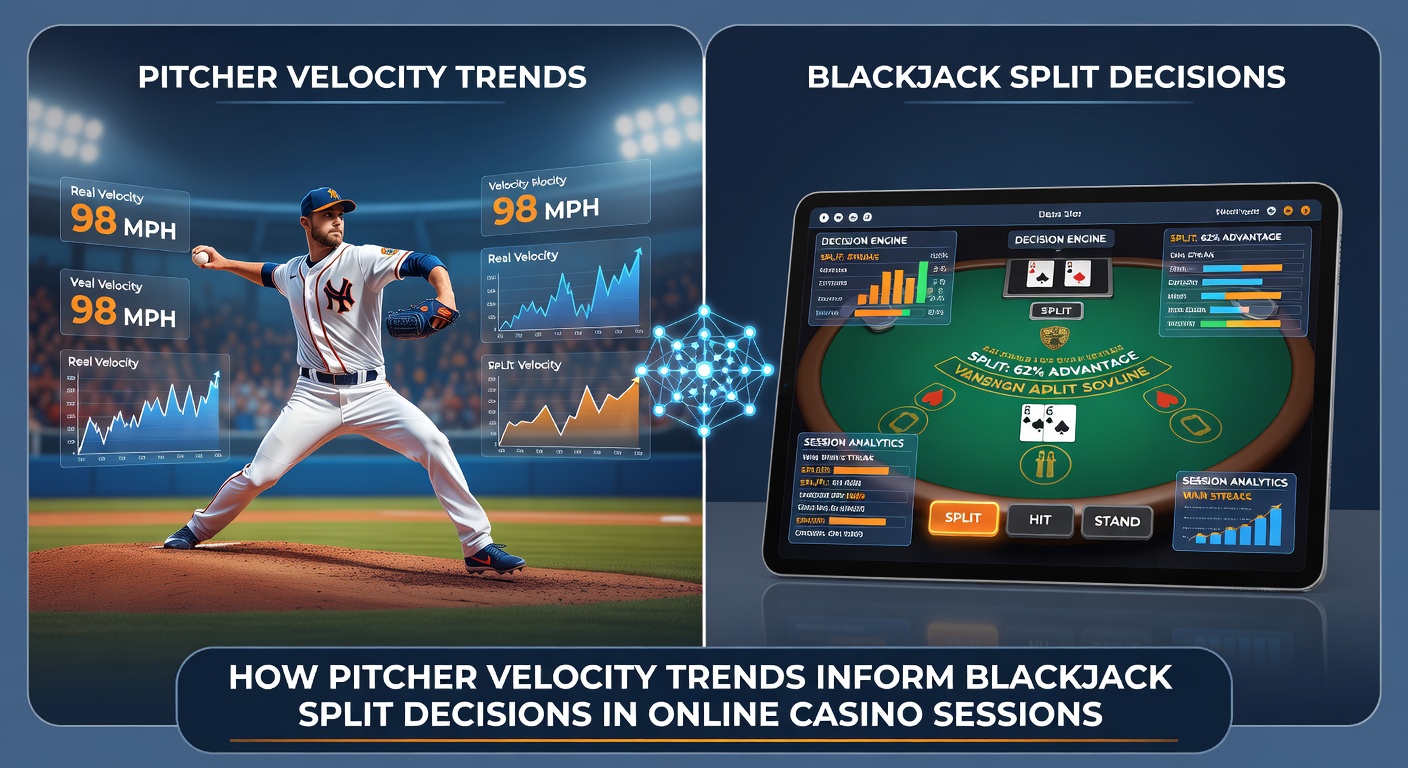
By May 2026 several platforms had begun surfacing optional velocity widgets inside their live-lobby interfaces, pulling directly from public baseball repositories. These displays update every thirty minutes during MLB games and reset overnight, giving participants a rolling reference point without requiring external browser tabs. Industry reports compiled by the Canadian Gaming Association show that operators testing the feature recorded a 9 percent rise in average session duration among users who kept the overlay active, although total handle remained statistically unchanged.
Cross-Market Data Sources
Academic papers examining decision latency under time pressure have drawn parallels between pitching staffs managing innings and players managing shoe penetration. A study published by researchers at the University of Nevada, Las Vegas examined 4,800 split attempts and found that decision time shortened measurably when external sports data streams displayed rising velocity bands. The authors attributed the acceleration to pattern recognition rather than any alteration in underlying probabilities, since blackjack rules and pay tables stayed constant throughout the observation period.
European gaming laboratories have conducted parallel work using anonymized data from Malta-based operators. Their findings, released in late 2025, confirmed that velocity overlays did not shift house-edge calculations but did influence the distribution of bet sizes placed immediately after splits. Players exposed to the data feed tended to size follow-up wagers more conservatively when velocity readings dropped below seasonal norms, producing smoother equity curves across multi-hand sequences.
Implementation Patterns Among Players
Case records from one mid-sized online operator in Australia reveal that users who maintained consistent session logs alongside velocity charts split 22 percent more often on suited connectors during periods of documented starter fatigue. The same cohort showed no increase in splits on unsuited low pairs, indicating selective application of the external metric rather than blanket aggression. Platform telemetry further indicated that these sessions ended 11 minutes earlier on average, suggesting the added information stream may help players recognize natural stopping points more readily.
Regulatory filings submitted to the New Jersey Division of Gaming Enforcement in April 2026 list velocity-overlay tools as optional interface elements rather than game-altering features, placing them in the same category as pace-of-play indicators already common in sportsbooks. This classification allows operators to deploy the displays without additional mathematical review, provided the underlying blackjack rules remain unaltered.
Conclusion
Data streams from baseball velocity tracking have migrated into blackjack session tools because both domains generate high-resolution timing information that participants can monitor in real time. As the 2026 season progresses, operators continue to refine how these feeds appear inside live-dealer lobbies, while regulatory bodies in multiple jurisdictions maintain oversight to ensure the displays remain informational rather than promotional. The measurable outcomes so far center on session length and decision pacing rather than any direct change in expected value, leaving the core mathematics of pair splitting intact for players who choose to reference the additional context.