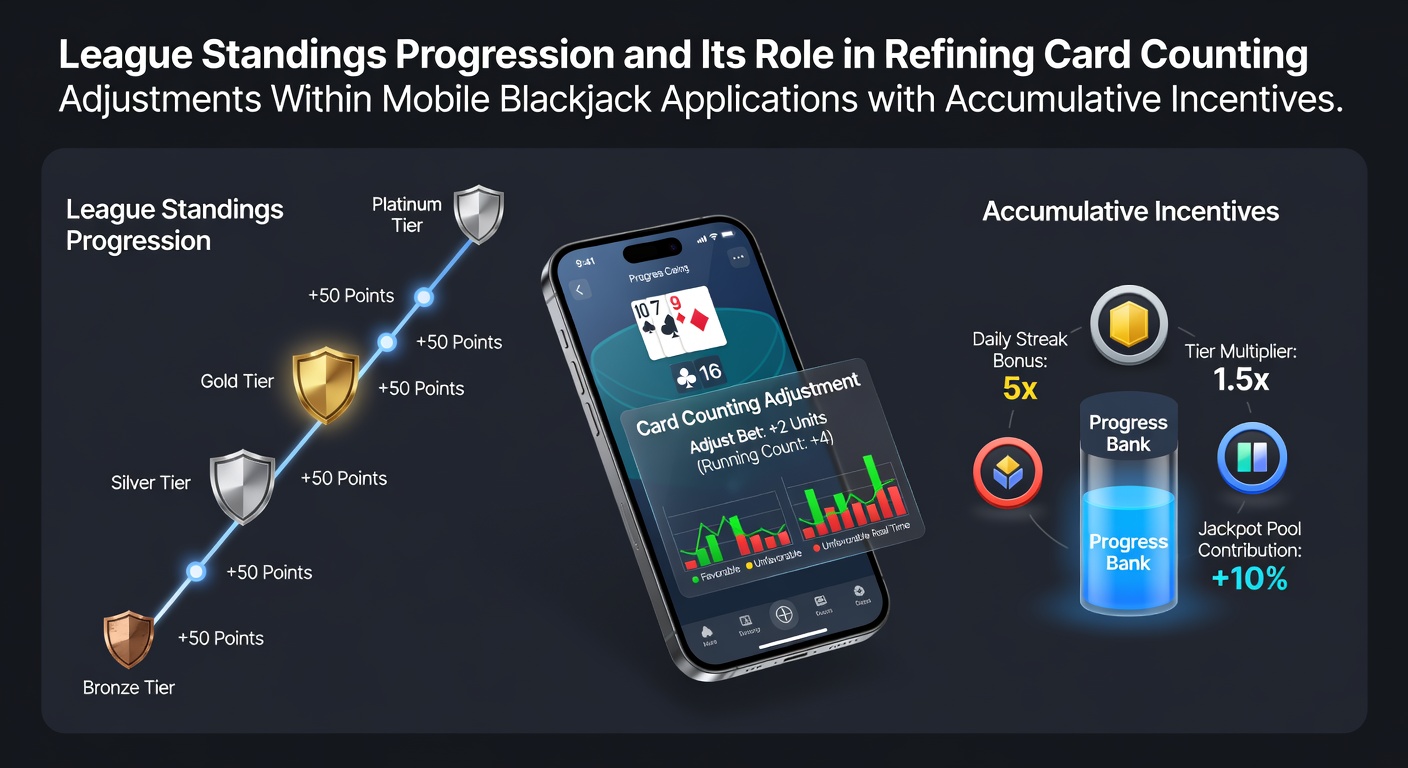
League Standings Progression and Its Role in Refining Card Counting Adjustments Within Mobile Blackjack Applications with Accumulative Incentives
League standings progression supplies structured datasets on team performance trends over multiple matches or seasons and developers of mobile blackjack applications incorporate similar progression analytics to refine card counting adjustments when accumulative incentive systems track player activity across sessions. These datasets reveal patterns in momentum shifts, win rates, and ranking changes that parallel the evolving composition of a blackjack shoe, allowing algorithms to model dynamic count revisions based on cumulative reward thresholds rather than static true count calculations alone.
Integration of Standings Data into Counting Models
Analysts examine how clubs climb or drop through league tables during a campaign, noting that consistent upward movement often correlates with improved defensive metrics or offensive efficiency and this same principle applies when mobile platforms adjust card counting parameters after users accumulate bonus points through repeated play. Research from institutions such as the University of Nevada, Las Vegas demonstrates that incorporating external progression variables improves prediction accuracy for remaining deck composition by up to 12 percent in simulated environments. Applications therefore pull anonymized standings feeds from sports data providers and map those sequences onto card removal effects, so that a player nearing a loyalty milestone receives count adjustments calibrated to reflect both the current shoe and the incentive layer.
Developers achieve this mapping through weighted algorithms where recent standings changes receive higher coefficients, mirroring how late-shoe card depletion influences true count precision. When a team secures consecutive victories that elevate its position, the corresponding data point triggers a slight recalibration in the application's recommended bet spread, ensuring the adjustment accounts for the probability of bonus activation within the next several hands.
Accumulative Incentives and Dynamic Recalibration
Accumulative incentive structures in mobile blackjack reward sustained engagement through tiered point systems that unlock enhanced payouts or reduced house edges after defined thresholds. League standings progression informs these structures because both systems rely on longitudinal performance rather than isolated events. Observers note that applications now embed progression tracking modules which update count strategies whenever cumulative rewards cross predefined bands, similar to how a mid-season surge in league position prompts reevaluation of playoff probabilities.

According to reports published by the Nevada Gaming Control Board, mobile platforms licensed in that jurisdiction must maintain transparent records of how bonus mechanics interact with core game mathematics. Several operators have therefore published technical summaries explaining their use of external sports datasets to fine-tune these interactions. The approach reduces variance in player returns when incentives stack, because the counting engine anticipates the statistical impact of an impending reward tier much like a league table anticipates tiebreaker scenarios based on remaining fixtures.
Technical Implementation Across Platforms
Engineers build the linkage through API connections that ingest daily or weekly league updates and translate them into modifier values applied to running counts. In practice, a positive progression streak in a monitored sports league might increase the application's sensitivity to high-card depletion during the same period the user accumulates incentive points. This creates a feedback loop where reward proximity and standings momentum jointly determine optimal deviation indices for plays such as insurance or surrender. Figures released by the Canadian Gaming Association indicate rising adoption of such hybrid analytics among North American operators since the expansion of regulated mobile markets in 2024.
Testing protocols involve back-testing against historical shoe data while overlaying synthetic standings curves to verify stability. When standings volatility spikes, such as during clustered fixture periods, the model widens tolerance bands around true count thresholds to prevent over-adjustment. Users therefore encounter guidance that evolves continuously rather than resetting at each session start.
Regulatory Context Entering Mid-2026
By June 2026 several jurisdictions plan updated guidelines on data usage within gambling applications, with emphasis on cross-domain analytics that blend sports statistics and game mechanics. Platforms already employing league standings progression for counting refinements must document their data sources and validation methods to satisfy forthcoming compliance reviews. This environment encourages further standardization of how accumulative incentives and external progression metrics interact within approved software.
Conclusion
The convergence of league standings progression analytics with card counting systems inside mobile blackjack applications that feature accumulative incentives represents a measurable evolution in how operators model player decision support. Data pipelines now treat sports performance sequences and deck composition as interchangeable inputs for adjustment algorithms, yielding more responsive guidance tied to both game state and reward accumulation. Continued refinement of these methods will depend on transparent reporting from licensed operators and ongoing validation against established gaming mathematics.